

 English
 中文简体
1: Introduction – Enhancing Comfort and Convenience with Car Armrests The Importance of Comfort in Modern Driving In today’s automotive landscape,...
READ MOREOct 26, 2026
A 40 W seat-heating pad on a 12 V supply draws about 3.3 A, while a pair of power-seat motors can spike past 20 A during start-up. Run that 20 A through a 5 m length of 18 AWG — a 10 m loop out and back — and the conductor's own 20.9 mΩ per metre removes roughly 4.2 V before the motor ever turns. That is the practical meaning of wire gauge: it decides how much voltage survives the trip. Gauge describes the conductor's cross-sectional area, the numbers run backwards (smaller number, thicker wire), and the correct value depends on current, run length, insulation rating and installation method — not on whatever was printed on the old harness.
Content
Gauge refers to the metal, not the jacket. Two cables labelled 16 AWG can look completely different once one carries thin-wall insulation and the other a heavy silicone sleeve, yet both conductors measure about 1.29 mm across. The American Wire Gauge system, still the default in North American automotive and marine work, defines that diameter precisely and derives the area from it.
18 AWG is a useful reference point: 1.02 mm conductor diameter, 0.823 mm² of copper, and 20.9 mΩ per metre at 20 °C. Three gauge steps change the area by roughly a factor of two, and six steps double the diameter — which is why 12 AWG (3.31 mm²) carries about four times the copper of 18 AWG rather than 50% more.
Metric cable is sold by area instead. A 2.5 mm² conductor sits close to 13 AWG, so treating "2.5 mm²" as a drop-in replacement for 12 AWG under-sizes the run by roughly one step. Fine-strand cable is often printed as strand count × strand diameter, such as 19 × 0.32 mm, and that notation says more about flexibility and termination behaviour than about current capacity.
AWG descends from the wire-drawing process: each pass through a die stretched the metal thinner and increased its gauge number, so a finer wire ended up with a larger label. The scale now runs from 4/0 (about 11.7 mm) down to 36 AWG and is fixed by standard rather than by any single manufacturer.
Ambiguity creeps in when a drawing simply says "gauge." British SWG and other legacy standards assign different diameters to the same number, so a 16 SWG conductor is not a 16 AWG conductor. For procurement documents, write the standard and the area together — "18 AWG, 0.82 mm², stranded copper" — and the argument disappears before the first sample ships.
Ampacity is the current a conductor can carry while staying inside its insulation's temperature limit. It is not a property of copper alone: ambient temperature, bundling, conduit fill and the connector at each end all shift the number. The values below are typical free-air chassis ratings for single conductors at 12 V DC; a harness taped into a dense bundle under a seat should be derated from them.
| AWG | Area (mm²) | Typical chassis rating (A) | Resistance (mΩ/m) | Where it usually appears |
|---|---|---|---|---|
| 20 | 0.52 | 11 | 33.3 | Switch backlighting, LED feeds, signal-level runs |
| 18 | 0.82 | 16 | 20.9 | Touch-screen harnesses, small relay coils, sensor power |
| 16 | 1.31 | 22 | 13.2 | Seat switch harness, 40 W heater branch |
| 14 | 2.08 | 32 | 8.28 | Single seat motor, blower, interior lighting trunk |
| 12 | 3.31 | 41 | 5.21 | Main power-seat feed, 30 A auxiliary circuits |
| 10 | 5.26 | 55 | 3.28 | Feed to an auxiliary fuse block |
| 8 | 8.37 | 73 | 2.06 | Battery-to-fuse-block link, inverter supply |
Read the table as a starting point, not a verdict. A 16 AWG conductor with 105 °C cross-linked insulation in open air behaves differently from the same conductor inside a loom at 60 °C ambient, and a 30 A fuse will never protect a 22 AWG pigtail. The termination is usually the weakest link: a correctly crimped terminal on 14 AWG outperforms a loose screw clamp on 10 AWG every time.
Ampacity answers "will the wire melt?" Voltage drop answers "will the device work?" At 12 V a 3% budget is only 0.36 V, and every metre of thin conductor spends part of it. The arithmetic is simple: drop equals current multiplied by loop resistance, where loop resistance is twice the one-way length times the per-metre figure.
The 20 A seat motor on 18 AWG loses about 4.2 V across a 10 m loop — a third of the supply. The same load on 12 AWG loses roughly 1.0 V, and on 10 AWG about 0.66 V. This is why long runs in a van or a converted MPV are upsized two or three steps beyond the ampacity table, particularly for control modules and touch screens that reset when the supply sags during a motor start.
Automotive harnesses rarely use solid conductor. Fine stranding tolerates vibration and repeated flexing at door hinges and seat rails, and it terminates more reliably in crimped contacts. Insulation choice drives both temperature rating and wall thickness: thin-wall TXL or GXL cross-linked polyethylene is common in engine bays, while silicone sleeves appear near heaters and other hot zones.
Match the temperature class to the real environment rather than the cabin. A heated pad can sit safely under upholstery, but the feed to it still runs past moving rails, so abrasion resistance and strain relief matter as much as the gauge number. Equally, an IP65 connector does not upgrade the conductor behind it; sealing and current capacity are separate questions answered by separate data.
Ask for those derating assumptions in writing. A supplier who can show the calculation — current, loop length, ambient, bundle — is far easier to work with when a prototype misbehaves at −10 °C or a customer reports flickering interior lighting after a seat upgrade.
Most aftermarket electrical faults trace back to one of three causes: a control module fed through an undersized pigtail, a harness spliced without accounting for loop length, or an accessory whose real current draw was never measured. A control unit that switches several relays through a compact connector concentrates all three risks in one part, which is why its rated current per channel, connector type and IP class belong in the same conversation as the wire feeding it. The diagnostic side of that relationship is covered in this guide to vehicle control module functions and diagnostics.
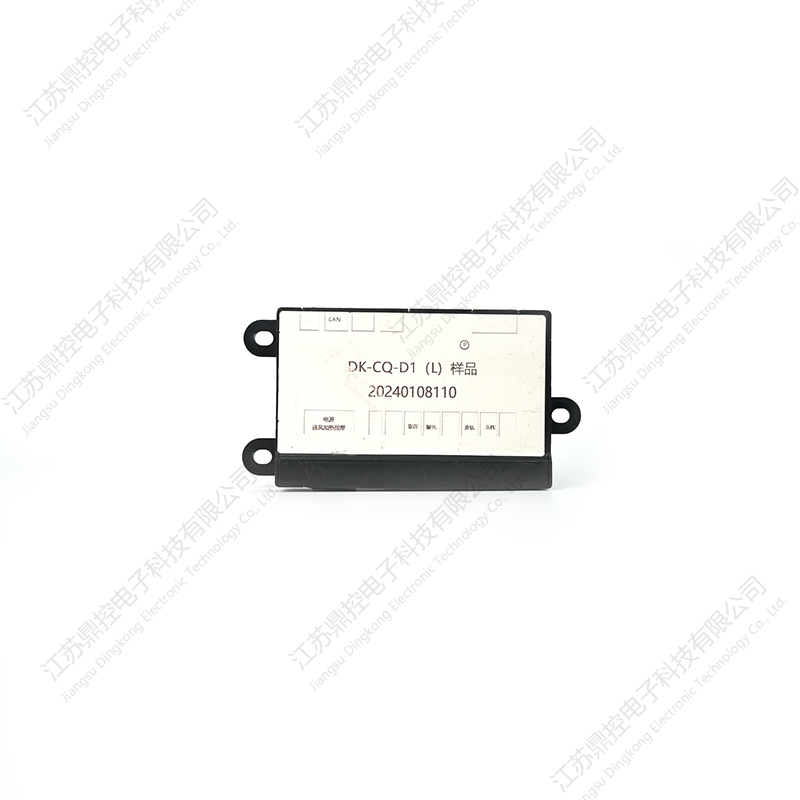 DK-7.0 Vehicle Control Unit for Electronic RetrofitsA compact IP65 control module for power seats, lighting and soft-close doors, with industrial-grade chipsets and broad vehicle compatibility.View Product →
For custom builds where the harness is designed alongside the electronics, ordering conductor, terminals and sleeving as one assembly removes the mismatch between a 0.5 mm² contact and a 1.0 mm² wire. Custom harness work is normally specified circuit by circuit, with each leg carrying its own gauge, colour code and length tolerance.
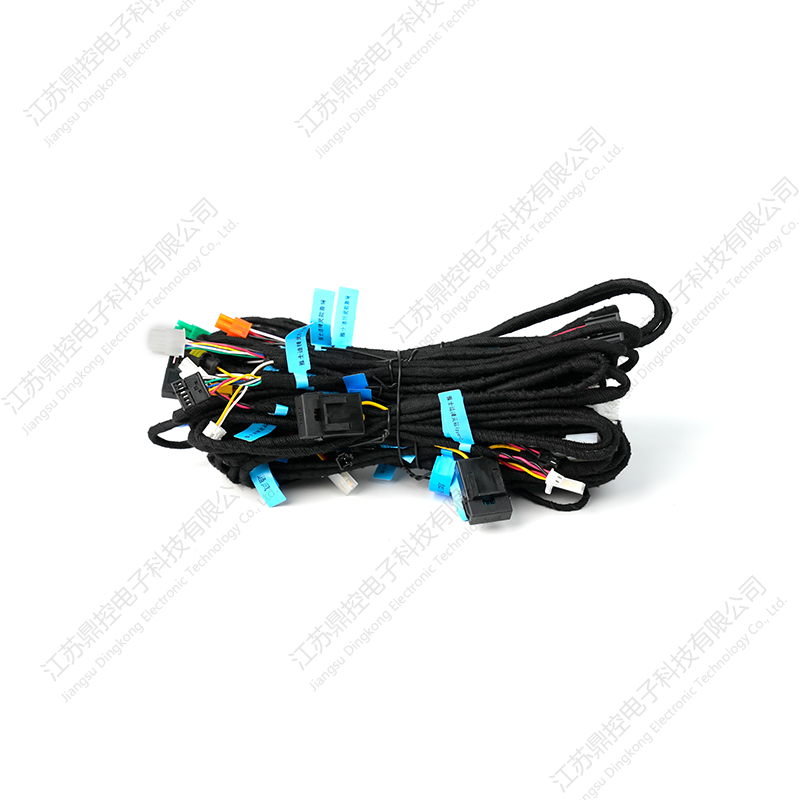 Vehicle Wiring Harness for Tesla, Benz and BMWCustomizable oxygen-free copper harness with IP67 protection and 1A–150A support, suited to replacement or performance modifications on Tesla, Benz and BMW vehicles.View Product →
Comfort hardware follows the same logic, and seat heating, ventilation and massage modules are a good example. A pad rated 40 W at 12 V needs only about 3.3 A, so 18 AWG is generous over a short run — but if the same circuit also feeds ventilation fans and a massage pump, the combined current sets the feed gauge while the pad's own tail stays small. Size each branch separately, then size the feed to the sum; the loom stays compact without pushing voltage drop past the budget.
 12V Smart Carbon Fiber Heated Seat PadA 40 W, five-level heated seat pad with fast carbon-fiber warmth, PID control and IP67 protection, sized for 12 V vehicle comfort circuits.View Product →
Wire gauge comes down to a three-part decision: enough copper for the current, enough area for the distance, and insulation plus terminations suited to where the cable actually runs. Get those three right and most 12 V electrical complaints — slow motors, resetting screens, warm connectors — never reach the warranty desk at all.
1: Introduction – Enhancing Comfort and Convenience with Car Armrests The Importance of Comfort in Modern Driving In today’s automotive landscape,...
READ MOREI. IntroductionThe automotive industry is undergoing constant evolution, with a growing emphasis on vehicle maintenance and personalization. For car o...
READ MORE1. Introduction The Tesla Model 3 and Model Y have quickly become two of the most popular electric vehicles on the market. With their sleek designs, i...
READ MORE
Jiangsu Dingkong, No.1, Menlouxia, Changjing Town, Jiangyin City, Jiangsu Province, China
Copyright © 2024 Jiangsu Dingkong Electronic Technology Co., Ltd. All Rights
Reserved.
 Auto Aftermarket Accessories Manufacturers