

 English
 中文简体
中文简体1: Introduction – Enhancing Comfort and Convenience with Car Armrests The Importance of Comfort in Modern Driving In today’s automotive landscape,...
READ MORESep 21, 2026
Specifying the wrong vehicle wire can turn an inexpensive harness into a source of heat, noise, and intermittent failure. The wire between a battery and a module carries more than current; it carries the design assumptions about temperature, vibration, and chemical exposure. For anyone sourcing automotive wire, standards such as SAE J1128, ISO 6722, JASO, and UL define the minimum performance that makes a cable acceptable for a specific installation zone. The practical conclusion is simple: select wire by operating temperature, voltage class, mechanical durability, and conductor size, then confirm the manufacturer has test data to back up the rating.
Content
Wire standards exist so that a cable will behave the same way on a production line and in service. They do not specify one material for every vehicle; they define the lower limits for several key characteristics.
These are not abstract approvals. A cable that passes a 125°C heat-aging test will keep its shape in an engine bay; one rated only for 80°C can soften and shift against metal edges. When you compare suppliers, ask which specific test methods were used, not just which mark is printed on the sleeve.
AWG tells you the conductor cross-section, but only that. An AWG 16 wire with PVC insulation and an AWG 16 wire with cross-linked polyethylene insulation can look nearly the same and still support very different operating temperatures. The same problem appears with metric sizes: a 1.5 mm² conductor satisfies the cross-sectional area, but the insulation material and wall thickness determine where the cable can be installed.
No single number is enough. A harness buyer should read the full cable designation, including insulation code, temperature class, voltage rating, and the standard that governs it. If a datasheet only says “16 AWG,” the drawing is incomplete.
SAE J1128 is the most common reference for low-voltage primary cable in North American passenger vehicles. It defines cable types such as GPT for general-purpose interior and chassis wiring and cross-linked types such as GXL and SXL for higher heat locations. SAE J1292 moves one level higher and covers the application of primary wiring distribution system harnesses to automobiles and motor coaches, including routing, protection, and installation practice.
If you export to or sell into the North American service market, you will see SAE cable markings constantly. Choose the SAE type that matches the local temperature and physical exposure.
ISO standards are common in global OEM and Tier 1 engineering. ISO 6722 defines single-core cables for road vehicles, with separate sections for 60 V and 600 V applications, and it groups cables by temperature class and insulation material. ISO 14572 covers sheathed round cables, both screened and unscreened, for complete harness assemblies. These standards make international sourcing simpler because the cable class is stated in a compact form.
Japanese vehicles often use JASO standards, which appear on OEM harnesses and replacement cables produced for the Japanese market. European designs frequently refer to DIN standards such as DIN 72551 for motor vehicle wiring. If a supplier substitutes a cable from one system into another, confirm that the insulation thickness, temperature class, and voltage rating are equivalent. The outer diameter may look the same while the inner wall is different.
UL is a safety certification system rather than an automotive environmental standard. It focuses on fire resistance, electrical safety, and traceability of materials. Many harness manufacturers use UL-rated wire in addition to SAE or ISO construction because downstream equipment certification requires it. UL marks are useful, but they should not replace SAE or ISO temperature and fluid-resistance tests for vehicle use.
| Standard | Voltage Class | Typical Temperature Range | Common Use |
|---|---|---|---|
| SAE J1128 | 60 V DC | 80-125°C | Primary wiring for vehicles, trailers, and engine compartments |
| ISO 6722 | 60 V / 600 V | Depending on class | Single-core automotive cable, including EV high-voltage circuits |
| ISO 14572 | 60 V / 600 V | Depends on inner cable class | Sheathed or shielded harness assemblies |
| JASO | 12 V / 24 V | Similar to ISO | Japanese OEM harnesses and replacement wiring |
| DIN | 12 V / 24 V | Varies by document | European passenger car wiring |
The table is a starting point, not a substitute for the full document. Always verify the specific cable specification before production.
Decision order matters. Choose the installation environment first, then the electrical load, then the connector. A circuit that runs under the carpet with moderate temperatures can use a basic PVC cable. The same circuit routed inside the engine bay needs a higher temperature class and oil-resistant insulation.
A real example: heated seat kits often pass through the seat harness near foam and heater mats. The wire surface sits close to a heat source, so the insulation must be rated above the worst-case local temperature, not just the cabin ambient figure. A similar mistake occurs in door looms where repeated flexing needs a finer-stranded conductor and abrasion protection.
A datasheet mark is not enough. The most common risks in automotive wire sourcing are copper-clad aluminum conductors, thinner insulation walls, and temperature labels that do not match the base material. These problems are hard to see in a photograph, so use physical and documentary checks.
Once you define the electrical and mechanical requirements, a vehicle-specific harness can remove a lot of uncertainty. The custom automotive wiring harness we build for Tesla, Benz, and BMW applications is designed with the original connector positions and routing constraints in mind.
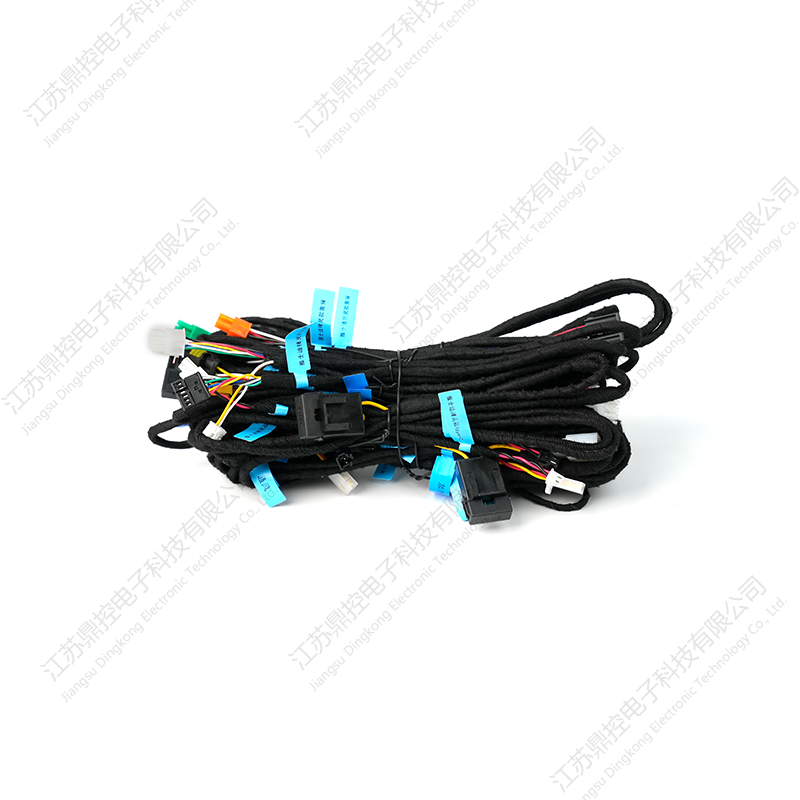 Custom Automotive Wiring Harness for Tesla, Benz, and BMWThis tailored harness matches original connector positions and routing constraints, making it a practical choice for retrofits, seat upgrades, or control-module installations where load-specific wiring matters.View Product →
That approach works well in retrofits, seat upgrades, and control-module installations because the wire type can be matched to the expected load and environment instead of being treated as a generic commodity.
A harness does not act alone. It connects switches, sensors, control modules, and loads, and a voltage drop or intermittent connection can appear as a module failure rather than a wire defect. If you are troubleshooting a system that uses electronic control modules, our guide to vehicle control module functions gives a clear picture of how inputs and outputs interact with the wiring.
The same principle applies when a new supplier offers a “standard” cable at a very low price. Standards have a cost: they require correct copper, controlled insulation thickness, reproducible extrusion, and batch testing. When a price is too low, the missing cost usually shows up in the conductor weight, jacket wall, or test coverage. Start with a known standard, verify the production evidence, and keep the complete circuit in mind.
1: Introduction – Enhancing Comfort and Convenience with Car Armrests The Importance of Comfort in Modern Driving In today’s automotive landscape,...
READ MOREI. IntroductionThe automotive industry is undergoing constant evolution, with a growing emphasis on vehicle maintenance and personalization. For car o...
READ MORE1. Introduction The Tesla Model 3 and Model Y have quickly become two of the most popular electric vehicles on the market. With their sleek designs, i...
READ MORE
Jiangsu Dingkong, No.1, Menlouxia, Changjing Town, Jiangyin City, Jiangsu Province, China
Copyright © 2024 Jiangsu Dingkong Electronic Technology Co., Ltd. All Rights
Reserved.
 Auto Aftermarket Accessories Manufacturers