

 English
 中文简体
中文简体1: Introduction – Enhancing Comfort and Convenience with Car Armrests The Importance of Comfort in Modern Driving In today’s automotive landscape,...
READ MORESep 09, 2026
When a vehicle control module quits mid-installation, the first thought is usually a failed relay or a software glitch. In practice, the fault often sits at the connector: a sealed terminal pushed into the wrong cavity, a wire gauge that cannot carry the current, or a shell rated for dry cabin use that has been mounted where road spray reaches it. The connector type is not a cosmetic detail. It is the boundary between a reliable automotive electrical system and a service call that wastes hours.
Content
Automotive connectors can be grouped in several ways. The most useful grouping for buyers and technicians is by function, by construction, and by termination style.
| Attribute | Options | Typical application |
|---|---|---|
| Sealing | Sealed vs. unsealed | Sealed for engine bay and underbody; unsealed for cabin electronics |
| Interface | Wire-to-wire vs. wire-to-board | Harness-to-harness for repairs; harness-to-PCB for control units |
| Contact plating | Tin, nickel, or gold | Tin for power; gold for low-voltage signal contacts |
The choice between these attributes changes the connector's resistance to corrosion, contact resistance, and serviceability. Sealing, in particular, is the most overlooked factor in retrofit and custom wiring work.
Even though family names vary, most connectors in a passenger car or commercial vehicle fall into a handful of families.
Pin and socket connectors rely on a male pin that slides into a female spring contact. They are common in chassis wiring, door harnesses, and seat controls. The pin diameter and spring tension determine the allowable current and insertion force. In seat power systems, a 2- or 4-way pin connector often supplies both motor power and switch signals.
Blade terminals, also called spade terminals, use a flat metal tongue pressed into a receptacle. They are easy to crimp and remove, which makes them popular for lighting, generator, and auxiliary circuits. However, blade terminals are less resistant to vibration than sealed multi-pin connectors unless they are combined with a retaining clip or heat shrink.
Coaxial connectors carry high-frequency signals for antennas, camera feeds, and some sensor applications. In modern vehicles, FAKRA-style connectors are widely used for RF systems. Data connectors for USB, Ethernet, and LIN are also growing in importance as infotainment and telematics modules expand. For these signals, consistent contact pressure and shielding matter more than current capacity.
Where moisture, dust, and salt are present, a sealed multi-pin connector with an integral grommet and sealing ring is mandatory. These connectors are standard on engine control units, transmission modules, and wheel-end sensors. They also protect body control modules in vehicles that undergo frequent washing or off-road use.
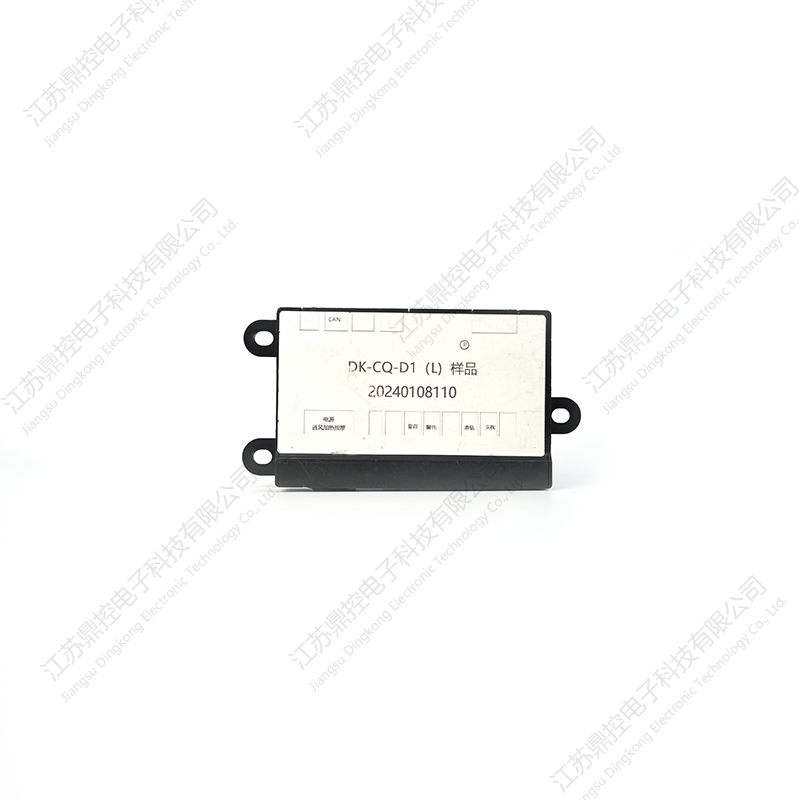 DK-7.0 Vehicle Control Unit with IP65 Sealed HousingThe DK-7.0 control unit features an IP65 dustproof rating, making it suitable for mounting in harsh environments. Its sealed design helps protect against moisture and dust, allowing installation closer to equipment while reducing wiring complexity.View Product →
An IP65-rated vehicle control module that uses sealed multi-pin connectors can be mounted closer to the equipment it controls, without the need to route harnesses into a sealed cabin. This reduces wiring length and simplifies service access. The DK7 control unit from Jiangsu Dingkong is one example of this approach.
Selecting a connector type without checking the real working environment is the main cause of early failures. A part that works in the cabin may fail quickly under the hood. The following factors should be reviewed before specifying a connector.
The connector must handle the continuous current of the load plus a margin for inrush. For a 12 V seat heater drawing 40 W, the connector sees about 3.3 A. A small signal connector might pass that current for a while, but its temperature rise and voltage drop will become excessive. Always check the wire gauge and terminal material together, not just the connector housing.
Sealing is expressed through ratings such as IP65, IP67, or IPX7. IP65 protects against dust and low-pressure water jets. IP67 protects against temporary immersion. For underbody connectors, IP67 is generally specified; for interior trim connections, IP65 is often enough. The sealing system must also survive temperature cycling without losing elasticity.
Vehicle vibration loosens contacts over time. Positive locking, secondary locks, and terminal position assurance (TPA) reduce the risk. The number of insertion/withdrawal cycles matters too: a connector that is opened for diagnostics may need 200 or more cycles, while a permanently connected harness joint may only need a few. For connectors that will be serviced often, choose a design with replaceable terminals and accessible locking latches.
When a harness is built for a specific vehicle model, the connector list becomes a BOM that must be exact. A mismatch in pin count, keyway, or terminal size can make a whole harness unusable. That is why custom harness manufacturers start by mapping every electrical interface before cutting any wire.
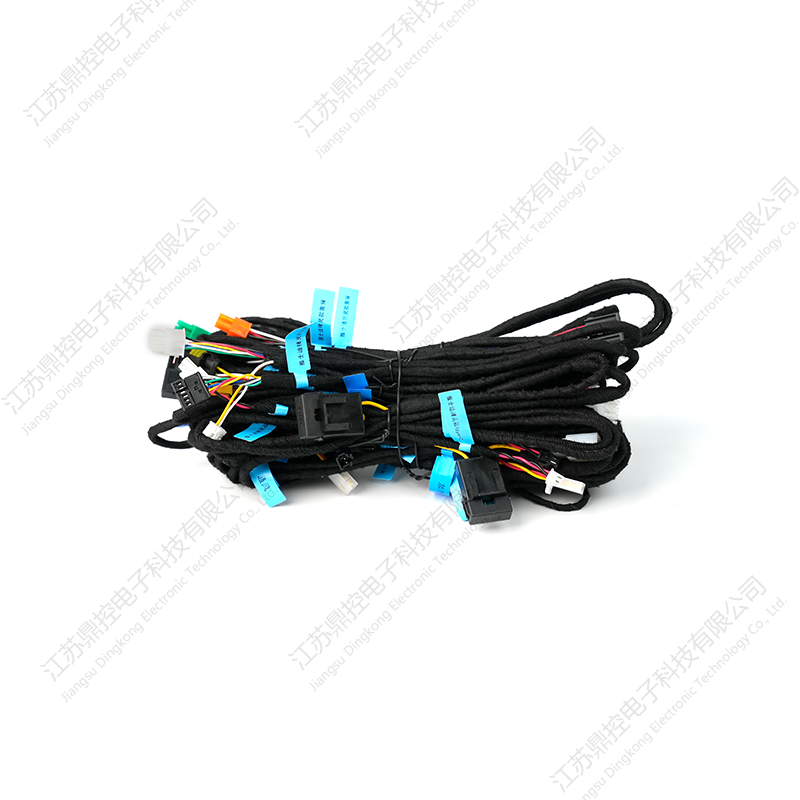 Custom Electronic Wiring Harness for Tesla, Benz, and BMWThis wiring harness is engineered for Tesla, Mercedes-Benz, and BMW vehicles, offering plug-and-play compatibility. It uses oxygen-free copper conductors and a flame-retardant TPE jacket, with options for full customization to meet specific vehicle requirements.View Product →
In our own custom automotive electronics work, we treat connector selection as part of the system design. For example, a custom automotive wiring harness for a specific vehicle platform must account for different connector generations and pin counts, even when the physical functions look identical. Using the correct OEM-style connector ensures that the harness can be plugged into the existing vehicle harness without modification.
For control modules with CAN and RS485 interfaces, the communication connectors must be shielded and twisted correctly. To learn more about how these modules use their connector interfaces, read our article on vehicle control module functions, components, and diagnostics. The same principles apply to custom seat switches, climate control panels, and touch-screen interfaces.
When you order a custom automotive wiring harness or a control module, the connector type should be stated in the specification, not left as an afterthought. Ask for the exact housing part, terminal material, wire gauge, sealing rating, and locking mechanism. A connector that holds up for years is built from those details, not from a generic label.
1: Introduction – Enhancing Comfort and Convenience with Car Armrests The Importance of Comfort in Modern Driving In today’s automotive landscape,...
READ MOREI. IntroductionThe automotive industry is undergoing constant evolution, with a growing emphasis on vehicle maintenance and personalization. For car o...
READ MORE1. Introduction The Tesla Model 3 and Model Y have quickly become two of the most popular electric vehicles on the market. With their sleek designs, i...
READ MORE
Jiangsu Dingkong, No.1, Menlouxia, Changjing Town, Jiangyin City, Jiangsu Province, China
Copyright © 2024 Jiangsu Dingkong Electronic Technology Co., Ltd. All Rights
Reserved.
 Auto Aftermarket Accessories Manufacturers